TL;DR: The traits that make founders and leaders dangerous (conviction, taste, doing things properly) can later make them brittle. When you start protecting your creation instead of the problem it once solved, your vision becomes a blind spot. The antidote is learning to critique your own masterpiece (and allow others to do the same) before your competitors do. Easier said than done.
There’s a moment in the life of any great creation when it stops being a tool and turns into identity. Proof you were right. The harder your fight for validation, the more fiercely you defend it. That’s when the curse begins.
The Pygmalion Pattern

In Metamorphoses, Ovid tells the story of Pygmalion as a maker who builds his ideal object and then becomes emotionally entangled with it. The sculptor carves a woman from ivory, falls in love with the work, and asks Aphrodite for a bride just like the statue. The creator’s attention and desire turn inward, towards a controllable, perfected product, rather than outward, towards evolving reality.
Like any myth it carries a warning. There is a recurring pattern in behavioural research where people overvalue what they have built or already own, and then defend it even when the environment shifts. The “IKEA effect” describes a measurable increase in valuation for self-made products. The endowment effect and status quo bias literature documents how ownership and an existing default can tilt judgement in favour of keeping what is already there, even when better alternatives exist.
Work on escalating commitment and sunk cost effects adds further reinforcement. With the investment of time, status, money, and identity, reversal becomes less likely even when negative evidence accumulates.
The modern Pygmalion story is easier to see when the product is not a statue but a category-creating product. When a successful product becomes the reference point, it becomes the lens through which its creator sees everything else.
A Modern Pygmalion
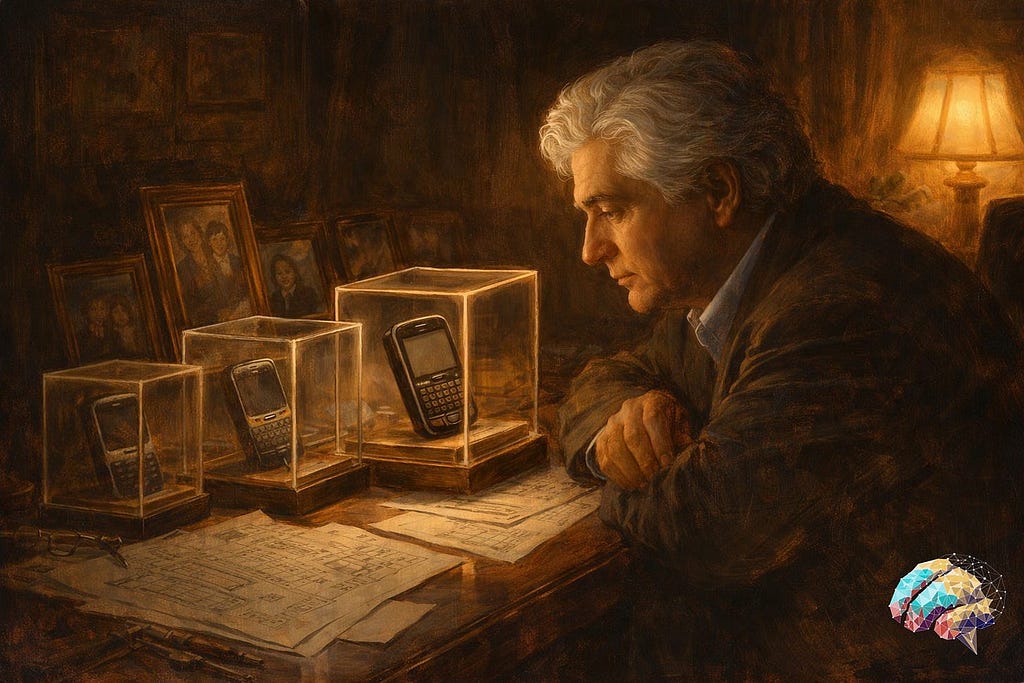
“The most exciting mobile trend is full Qwerty keyboards.” — Mike Lazaridis
In Losing the Signal, authors Jacquie McNish and Sean Silcoff describe how Mike Lazaridis’s early success at BlackBerry rested on a contrarian thesis. “The paradox of success”, Lazaridis wrote, “was that handheld devices did not need more functions; they needed fewer.”
The book then illustrates how this contrarian thesis eventually hardened into a reference model. Lazaridis’s attachment was both professional and personal. He carried a bag of devices to showcase new iterations and famously kept early BlackBerry models encased in Lucite on his desk, sharing space with family photographs. When a product reaches that level of significance, it shifts from tool to artefact.
Consequently, when engineers proposed new features, his first instinct was resistance. Colour screens, cameras, full web browsers, and video were all treated with scepticism. From his perspective, these additions drained batteries and clogged networks. His design philosophy rested on four elements that had defined BlackBerry’s success: long battery life, efficient use of carrier bandwidth, secure messaging, and the ability to type quickly on a physical keyboard. In that framework, engineers built useful tools for professionals, not media devices for consumers.
Within that model the decisions made perfect sense. Carriers feared bandwidth-heavy applications that could destabilise their networks. Enterprise customers worried cameras might expose sensitive information inside the workplace.
However, clarity inside a model can lead to blindness outside it. While BlackBerry optimised for reliability and efficiency, the adjacent consumer market began rewarding the very same media-rich experiences Lazaridis dismissed.
This is the Pygmalion risk in organisational form. A product that once won can become a protected identity. Once that happens, the identity filters incoming signals. Category change is then processed through the old design logic, and concession becomes harder because it threatens the reference model that made the company successful.
Steve Jobs described the platform version of this trap in plain terms. A successful system can peak, then “decline slowly as its own software became its prison.” (from Steve Jobs in Exile, coming soon on The Innovation Show).
The BlackBerry story shows how that dynamic unfolds when the environment shifts.
They Put A Mac In This Thing
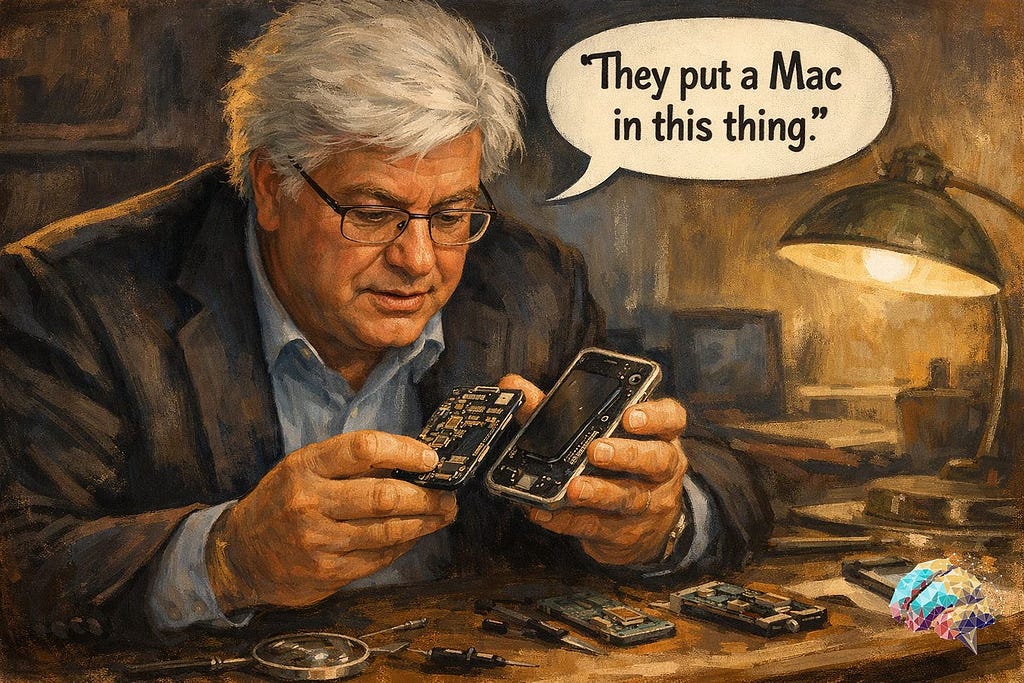
“If this thing catches on, we’re competing with a Mac, not a Nokia.” — Mike Lazaridis
In the summer of 2007, Mike Lazaridis cracked open a phone that gave him pause.
Like the boy who once dismantled radios in his basement laboratory, he regularly conducted what colleagues called “desktop autopsies” on rival devices. Usually the exercise reinforced his belief that BlackBerry remained the smartest handset on the market.
This time was different.
Examining the internals of Apple’s newly released iPhone, he reportedly looked up and said: “They’ve put a Mac in this thing.”
What he saw was not simply another handset. The iPhone was a small mobile computer. Its operating system alone required roughly 700 megabytes of memory, orders of magnitude more than the software footprint of contemporary BlackBerry devices. It carried a full Safari browser capable of roaming the open Internet. With AT&T backing the device, Lazaridis could see the direction of the industry shifting.
“If this thing catches on,” he warned engineers, “we’re competing with a Mac, not a Nokia.”
BlackBerry had transformed business communication by putting email in people’s pockets. The iPhone was attempting to put the Internet there.
Inside RIM, Lazaridis pushed engineers to respond quickly. The same engineers who had long argued for expanding BlackBerry’s Internet capabilities suddenly found an urgency behind their proposals that Lazaridis rejected .
Publicly, however, the company projected confidence.
“As nice as the Apple iPhone is, it poses a real challenge to its users. Try typing a web key on a touchscreen on an Apple iPhone, that’s a real challenge. You cannot see what you type.” — Balsillie, November 2007
Lazaridis and co-CEO Jim Balsillie dismissed the iPhone as an interesting but limited entrant. Lazaridis complained that typing on the touchscreen keyboard was difficult. Balsillie suggested Apple had merely validated the smartphone market.
Meanwhile the competitive environment was shifting rapidly. AT&T’s exclusive deal gave Apple a powerful distribution partner, while rival carriers such as Verizon and Vodafone were scrambling for a response to the consumer enthusiasm surrounding the device.
RIM accelerated its development of touchscreen devices and richer Internet capabilities. The response was driven by urgency as much as readiness.
In an irony that would become obvious years later, Steve Jobs had described exactly this trap decades earlier while building NeXT after being ousted from Apple. Successful platforms, he warned, eventually accumulate so much software and compatibility baggage that change becomes dangerous. At that point the system can peak and “decline slowly as its own software becomes its prison.”
The prison is not only in the codebase. It is in the model an organisation, and an individual, uses to interpret change.
It is hard to read the label from inside the jar.
BlackBerry shows the product level version of the trap. Nokia shows what it looks like when the same trap spreads across the organisation. In Nokia, the reference model did not live only in a device or a platform. It spread across reporting lines, meetings, and what people felt able to say.
That is the focus of this week’s Innovation Show, a multi part deep dive with Quy Huy of INSEAD and Timo Vuori of Aalto University. Based on interviews with more than one hundred Nokia insiders, from board members to middle managers, they show how signals about the smartphone shift were present, yet difficult to integrate, which helps explain how a company that held roughly half the global smartphone market in 2007 lost its lead, and how it later rebuilt.
https://medium.com/media/69ecba5f0b080813b3cbe0b006f36b69/href
Upcoming Exclusive for Paid Subscribers

A related conversation is coming up on March 31st. We’ll be joined by Greg Satell, author of Cascades and Mapping Innovation, to explore how change actually spreads and how ideas move forward without getting lost in noise, politics, or well meaning distraction.
Ahead of the session, I recommend Greg’s Fast Company article on mastering the three types of power needed to move ideas forward:
The Nokia and BlackBerry stories remind us that the signal is often already inside the organisation. The challenge is making sure it gets heard. Greg’s piece offers a useful lens on how to avoid becoming the engineer whose warning the organisation overlooks.
March 31st 2026
4:00 PM Irish | 5:00 PM CET | 11:00 AM EST | 8:00 AM PST
If you’d like to join, just reply and I’ll add you to the list.
When Vision Becomes a Blind Spot: The Founder’s Curse was originally published in The Thursday Thought on Medium, where people are continuing the conversation by highlighting and responding to this story.