“Life is a balance between holding on and letting go.” — Rumi
For 32 years, fourteen-year-old Stephanie Isaacson’s death remained unsolved as a cold case. The evidence sat on a steel shelf because the instruments available in 1989 fell short. The minute trace of DNA on a shirt was too faint to reveal the killer. In 2021, with techniques that did not exist when the box was first sealed, a lab built a profile from a mere fifteen human cells and the case was solved.
Stories like this change how we think about what we keep. They make us wonder about our own shelves. Perhaps that is why we keep screenshots, fuzzy photos, receipts in subfolders inside subfolders, back-ups of back-ups. Organisations do it at industrial scale, drives full of logs and metrics “just in case.” For some CTOs it is patches atop patches, with hardware on life support, kicking the can down the road and delaying the clean slate that is desperately required.
I call this reflex the F.O.T.O. dilemma: the fear of throwing out. Or, as The Clash might put it, should I keep or should I throw. In Originals, Adam Grant tells a story that sharpened this dilemma for me.
When Footnotes Become The Finding

Economist Michael Housman was trying to explain why some customer-service agents stayed in their roles longer and performed better. The usual variables revealed nothing. Then akin to the cold case DNA left on a shelf, a random field the team had kept, the browser applicants used, suddenly mattered. It revealed that people who had moved off the default to Firefox or Chrome tended to stay longer, miss fewer days, and score higher with customers. It was not the browser itself, but the habit signalled by changing it: a small act of agency that travelled with other proactive behaviours. The cold case waited for better instruments as the browser field waited for a better question.
What struck me was not only the insight about people. It was that the insight existed at all because someone kept what looked like (at the time) an irrelevant detail. If that field had been dropped from the data, the pattern would have never emerged. That is the inner voice we hear when we attempt to throw out to press delete. In trying not to miss the one detail that might matter tomorrow, we carry a growing weight of data today. That, for me, is the heart of the F.O.T.O. dilemma.
The safest choice was to keep everything, but there is a cost to that choice. You feel it when you open a cloud folder intending to delete old junk, but close it again because the task is too big. Teams feel it when dashboards proliferate and every version of every spreadsheet is preserved. Storage is cheap, but attention is not. Every extra field and every additional log demands interpretation time, and interpretation is where judgement lives. It reminds me of a story by Jorge Luis Borges.
Keeping Everything

In Funes the Memorious, Borges tells of Funes, a teenager who, after being thrown from a horse and left paralysed, acquires a memory that will not release a single detail. He can replay an entire day minute by minute. The shape of a passing cloud or the angle of a dog at 12:01 and at 12:02 are different facts he stores separately. He even tries to invent a numbering system that gives every number its own unique name, a project that collapses under the weight of its own precision. The point is clear: without some forgetting there is no abstraction, and without abstraction there is little room for thought. Many of us do this with our lives too, clutching painful memories, grudges and old grandeur; when we harbour the past, we spend the energy we need to create the future.
Funes is also a mirror for the technology stack. Nowhere is the pull to remember everything stronger than in enterprise architecture, where every interface, integration and log has a history. Patching feels prudent because it avoids loss, yet it leaves us with precision and little perspective.
F.O.T.O. in the stack
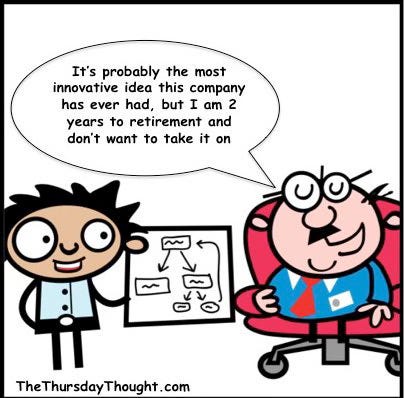
A CTO inherits a tech stack that was expensive to build, painful to integrate and to get over the line with the CFO. The board wants reliability. The business wants new features and they want them last year. Transformation feels like all cost and no applause. So the CTO keeps patching, deferring a clean slate. They tell themselves they will rebuild when the quarter is quieter, when budgets bigger, or when the roadmap is clearer. The need for change continues to pile. The can gets kicked, eventually and hopefully until retirement?
There is another reason we keep layering. In an age of AI the next wave may not be an upgrade. It may be what my friend Sangeet Paul Choudary calls a total reshuffle. Conway’s Law still applies, namely the way we are organised shapes the way our systems are built. And the way our systems are built pushes back on how people are organised. If AI changes the work, the architecture must also change, which means the org chart should change. A patch won’t cut it, we must unbundle and rebundle. In the unbundling we will uncover redundancies (in every sense), and when we rebundle the modules, the org will look much different (and smaller) than it once did.
This is where FOMO meets F.O.T.O. We fear missing out on a future capability, so we fear throwing out any part of the past. We keep middleware that no one loves because it still links two vital systems. We keep data pipelines that long ceased to provide any value. But wait! one day they might feed a future AI model? We keep monoliths on life support because the severance cost, the retraining cost, and the political cost feel larger than the benefit we can prove this quarter.
There is a way through that does not demand a hero move. As Sangeet Paul Choudary suggests we think both inside-out and outside-in. Inside-out asks what capabilities do we actually have and how must they evolve. Outside-in asks where is value moving on the playing field. Two forces help you see the shift. Complementarity and commoditisation. Data made distant industries complementary. AI is doing the same for messy knowledge. At the same time, technology keeps commoditising what once held the margin. If a chunk of today’s “expertise” collapses to a prompt, value will move elsewhere. Architecture must move with it.
On the personal side, we can apply a similar hygiene. Give screenshots a yearly amnesty. For photos, keep the best version of an event and release the near-duplicates. In inboxes, move from hoarding to harvesting or just delete the lot and see who emails back.
Perfection here is not endless storage. Antoine de Saint-Exupéry put it well in Terre des hommes: “Perfection is achieved not when there is nothing more to add, but when there is nothing left to take away.”
The F.O.T.O. tension will not disappear. Cold cases remind us that patience can be wise when it is tied to purpose and revisiting. Borges reminds us that too much fidelity can make thinking impossible. Peter Drucker’s answer was planned abandonment: “The first step in a growth policy is not to decide where and how to grow. It is to decide what to abandon.” (Managing in Turbulent Times, 1980.)
The safest choice is not to keep everything, but to keep purposefully (or mindfully), review on purpose, compress into learning, and let the rest flow so the living parts of the system can breathe.
This week’s Thursday Thought was inspired by our episode with Sangeet Paul Choudary, Howard Yu and Alex Osterwalder.
https://medium.com/media/e2577679559bed06af1cfb7b110c11bf/href
Part 2 of 3 with Chuck House drop is just live below.
https://medium.com/media/1231268ca819166ede2ca2cebbf84fa2/href
The F.O.T.O. Dilemma: The Fear of Throwing Out was originally published in The Thursday Thought on Medium, where people are continuing the conversation by highlighting and responding to this story.