YouTube thumbnail for an episode titled “AI Is Rewiring Organizations,” showing a smiling male host with a microphone beside four guest headshots in a video-call grid. Large bold text reads “AI IS REWIRING ORGANIZATIONS” with the subtitle “From Billable Hours to Permissionless, Outcome-Driven Work.” Blue AI circuitry, an upward arrow, and icons for time, access and outcomes reinforce the theme of AI changing organisational work models.

AI Is Rewiring Organisations — McGrath, Osterwalder, Amla & Sheikh

A single developer sold an $80 million company to Wix in six months. In this Kyndryl Institute panel, Rita McGrath, Alexander Osterwalder, Ismail Amla and Usman Sheikh explain how AI is rewiring organisations — killing the billable hour, flattening power, and shifting work from hours to outcomes.
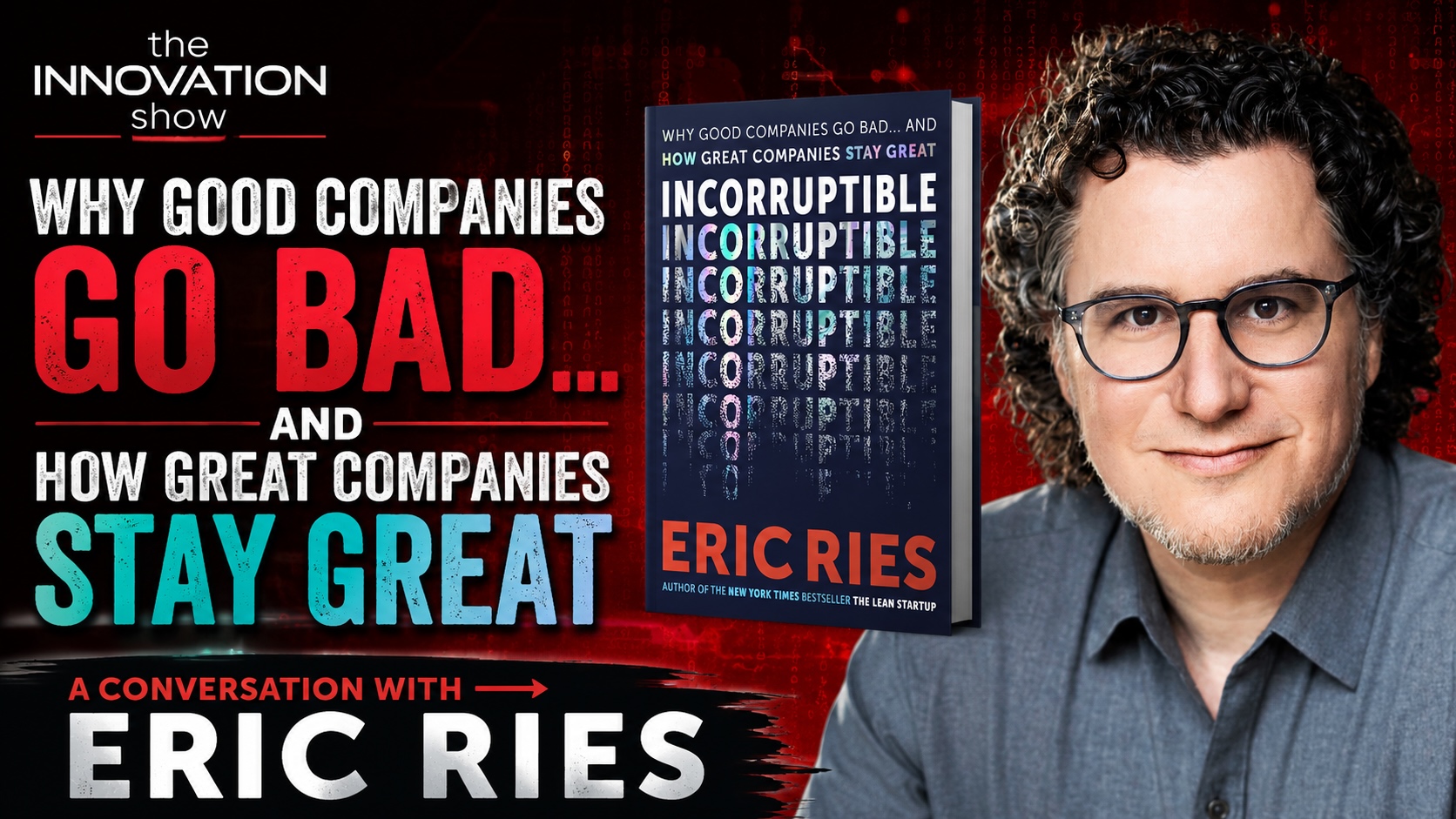
YouTube thumbnail for The Innovation Show featuring entrepreneur and author Eric Ries beside the cover of his book Incorruptible. The background is a dark red digital matrix style with glowing code and network graphics. Large distressed typography reads “Why Good Companies Go Bad… And How Great Companies Stay Great.” Eric Ries appears on the right in glasses and a grey shirt, while the book cover floats beside him. Bold red, white and turquoise text creates a dramatic business and innovation aesthetic.

Eric Ries — How to Build an Incorruptible Organisation

Eric Ries — author of Incorruptible and founder of the Long-Term Stock Exchange — joins Aidan McCullen to expose the hidden forces that corrupt mission-driven organisations. From financial gravity and the golden goose problem to the LTSE ambush and the Costco governance fortress, this is a blueprint for building an incorruptible organisation that lasts.

Bruce Vojak on identifying, developing and managing serial innovators — The Innovation Show with Aidan McCullen

Bruce Vojak — Identifying, Developing and Managing Serial Innovators (Part 3 of 3)

Bruce Vojak closes our three-part Serial Innovators series with the playbook for finding and protecting breakthrough talent: the five core traits to look for, the four engagement filters that actually identify a serial innovator, why HR and AI hiring screens filter them out, and the manager behaviours — air cover, patience, no “J work” — that keep them from walking out the door.

Bruce Vojak, co-author of Serial Innovators, on navigating the politics of breakthrough innovation — stakeholder alignment, building trust, champions and influencers, and turning organisational politics into progress

Bruce Vojak — Navigating the Politics of Breakthrough Innovation (Part 2 of 3)

Most innovators believe a great idea will sell itself. Bruce Vojak, co-author of Serial Innovators, joins Aidan McCullen to reveal why that belief will get you fired — and how the rare few who repeatedly deliver breakthrough innovations inside mature firms actually navigate the organisational politics that stop everyone else cold.

A 16:9 promotional thumbnail for The Innovation Show bonus episode on The Innovators Hourglass Model with Bruce Vojak. The image shows Bruce Vojak’s portrait on the left, the cover of Serial Innovators near the bottom, and a colourful hourglass-shaped innovation process diagram on the right. Large bold text reads “The Innovators Hourglass Model,” with supporting text “with Bruce Vojak” and “Bonus Episode.

Bruce Vojak — The Hourglass Model of Breakthrough Innovation

Bruce Vojak returns for a short bonus episode on the Hourglass Model — the descriptive state diagram he and his co-authors built to explain how serial innovators actually move from a customer problem to a launched product, without the prescriptive rigidity of stage-gate.

Headshot of Bruce Vojak alongside the Serial Innovators book cover by Abbie Griffin, Raymond L. Price and Bruce A. Vojak — promotional banner for The Innovation Show book breakdown, Part 1 of 3, hosted by Aidan McCullen.

Bruce Vojak — Serial Innovators: The Hidden Power Inside Mature Firms (Part 1)

Bruce Vojak, co-author of Serial Innovators, explains why roughly 1 in 500 employees inside a large mature firm — with no formal mandate, often almost fired — create most of the breakthrough products that fund everything else.

Jeff and Staney DeGraff discussing the paradox mindset on The Innovation Show with Aidan McCullen

Jeff & Staney DeGraff — The Art of Change (DeGraff Trilogy Finale

Organisations love innovation, but they hate their innovators.” Jeff and Staney DeGraff close out the DeGraff trilogy with The Art of Change — the paradox mindset, the seven paradoxes, and why the man who saved Operation Warp Speed got passed over for promotion.

Jeff and Staney DeGraff on the creative mindset and the CREATE method on The Innovation Show

Creativity Is a Skill: Jeff & Staney DeGraff on the C.R.E.A.T.E. Method (Clarify to Evaluate)

Creativity is not a gift. It is a skill. Jeff and Staney DeGraff return for part two of the DeGraff trilogy with The Creative Mindset — and the six-step CREATE method (Clarify, Replicate, Elaborate, Associate, Translate, Evaluate) that turns ordinary teams into compounding inventors.

AI business transformation and distributed intelligence explained in the Octopus Organization model with Steven Wunker and Jonathan Brill

AI and the Octopus Organization: Autonomy, Distributed Intelligence, and Faster Decision-Making

What if your organisation could think and act like an octopus? In this episode, Steven Wunker and Jonathan Brill explore how AI is reshaping organisations through distributed intelligence, autonomy, and faster decision-making. Discover why success with AI depends less on technology—and more on rethinking culture, structure, and how decisions are made.

Nokia iPhone strategy failure analysis ecosystem disruption with Timo Partenen

Nokia Saw iPhone Coming – So What Went Wrong?

What if Nokia saw the iPhone coming—and still couldn’t stop it?
In this episode, former Nokia strategy and market intelligence leader Timo Partanen shares an insider view of the company’s internal iPhone threat briefing. Nokia had tracked Apple for years and anticipated the hardware shift—but underestimated the power of Apple’s ecosystem, partnerships, and business model.
We explore why warnings didn’t translate into action, how internal silos shaped decision-making, and what modern leaders can learn about disruption, strategy execution, and platform thinking.

Positive SSL